Monday, July 18, 2016

20 Mysteries: Jesus is Scourged

Matthew 27:26:

[26] Then he released to them Barabbas, and having scourged Jesus, delivered him unto them to be crucified.

Mark 15:15:

[15] And so Pilate being willing to satisfy the people, released to them Barabbas, and delivered up Jesus, when he had scourged him, to be crucified.

Luke 23:22-25:

[22] And he said to them the third time: Why, what evil hath this man done? I find no cause of death in him. I will chastise him therefore, and let him go. [23] But they were instant with loud voices, requiring that he might be crucified; and their voices prevailed. [24] And Pilate gave sentence that it should be as they required. [25] And he released unto them him who for murder and sedition, had been cast into prison, whom they had desired; but Jesus he delivered up to their will.

John 18:38-19:1:

[38] Pilate saith to him: What is truth? And when he said this, he went out again to the Jews, and saith to them: I find no cause in him. [39] But you have a custom that I should release one unto you at the pasch: will you, therefore, that I release unto you the king of the Jews? [40] Then cried they all again, saying: Not this man, but Barabbas. Now Barabbas was a robber.

[1] Then therefore, Pilate took Jesus, and scourged him.


Praised be Jesus Christ!

Now and forever. Amen.


Following Jesus' agony in the Garden of Gethsemani, Jesus is arrested by the betrayal of Judas. Jesus' Disciples all flee, abandoning Him to the authorities. Jesus is taken before the High Priest and the Sanhedrin. There, false accusations are brought against Him, and in the middle of it, Jesus pronounces the Holy Name in reference to Himself. This is regarded as blasphemy, for which the sentence is death. But because this sentence occurs during the Feast of the Passover, the Jews are not permitted to put Him to death at that time, so they present Him to the Roman authorities as a seditionist who was inciting the people to rebel against Rome, so that they might put Him to death lawfully.

Jesus is therefore taken before Pontius Pilate who interrogates Him, but Jesus remains silent before him. In Luke's Gospel, Pontius Pilate sends Jesus to Herod, because he realizes Jesus is from his district. Neither Herod nor Pilate find any fault in Jesus, and Pilate says so to the crowd that had gathered to witness Jesus' trial and execution.

The crowd, urged on by the chief priests, shout that Jesus should be crucified. Pontius Pilate, not wanting to put Him to death, offers the people, according to the custom of the Feast, the option to have one of two people freed: Jesus or Barabbas. The people ask for Barabbas to be released, and Jesus to be executed. Pilate permits their choice. Barabbas is freed, and Jesus is sent off to be scourged.

Barrabas


In the Gospels, this prisoner that is chosen over Jesus is called a robber, and was said to have been in prison for the crimes of murder and sedition. There are a number of things worth noting about this figure.

During Jesus' time, and in the centuries leading up to His coming, it was believed that the Messiah was going to be a military man, someone who would liberate Israel from foreign occupation. It was therefore not entirely uncommon for freedom fighters and rebels leaders to claim to be the promised Messiah, and throughout Israel's history, you had such figures pop up to lead attempted rebellions against foreign occupiers.

Barabbas was such a man. He had been arrested for sedition, and murder. Likely, he had incited acts of rebellion against Rome, like theft and violence. So, he was a Messiah figure. Moreover, his very name offers a striking juxtaposition against Jesus. Barabbas is a consonant name made up of two Aramaic words "Bar" and "Abbas", meaning "Son of the Father."

So, what we see here, when Pontius Pilate makes this offer, is a choice for the Jews between which kind of Messiah they would have for themselves. Their choice was between a military freedom fighter, who would liberate Israel from Roman occupation, and reinstate the Kingdom of Israel, as Israel's new king. Or something entirely different, someone who preached obedience to the ruling authority of an occupying state, who's central teaching was about inner obedience to the Law, not just outward obedience. Someone who claimed that His Kingdom was "not of this world."

This wasn't just about the Messiah, though, but it was also about what it means to be a "Son of the Father." Was "Son-ship" about earthly gain, health and prosperity, and self-governance? Or, was "Son-ship" about a righteous heart, and an obedient will?

This the essentially the choice the Jews faced in the selection. It is essentially the choice we all face when confronted with sin. The Jews chose Barabbas. The punishment for sedition was public torture and execution. Jesus, therefore, was sentenced to scourging and crucifixion.

Jesus is Scourged


In the place of the sinner, Barabbas, for whom such a punishment was just, the innocent Jesus willingly submits Himself to Roman scourging. This is a sign of the suffering He accepts as a consequence of all of our sins. It was a common procedure prior to crucifixion under Roman law, but it was brutal.

The whip that was used, both on Jesus, and in common practice at the time, was called a flagrum. It had a short handle, and two or three long, thick thongs. Each thong was weighted toward the tips by a lead ball or mutton thong. The thongs cut this skin, while the weights caused deep contusions, and internal hemorrhaging. The idea wasn't just to cause pain to the victim, but to break their wills, destroying their resistance to their impending execution.

Under Roman law, the number of lashes to be dealt had no limit. This was in contrast to Hebrew law, which limited the number of lashes to 40. The only limit to Roman law was that the prisoner had to be able to bear his cross to the place of execution. We know Jesus' scourging was unusually severe, because Jesus didn't have the strength to carry His cross to Calvary by Himself. This may be due to the fact that Jesus had an unusually strong will.

Take note of that, because Jesus would have been aware of how Roman executions were performed. He could have faked his resistance to His persecutors, in order to receive a less severe flogging. But He didn't, and He deliberately prolonged the scourge. For those who believe that the Shroud of Turin is authentic (and I do), the number of wounds that have been identified through it as lash wounds are between 100 1nd 120.

Jesus would have had His hands bound, tied to the column above his head, making Him unable to protect Himself with His arms. You can see that the image I have posted to this article is inaccurate in this regard. It's inaccurate in many regards, not the least of which is the lack of wounds to His body, or the serenity on His face. This isn't necessarily a bad thing, though, as such depictions are the result of a pious love for Our Redeemer, and a sensitivity toward the viewer.

If you are interested to see what else the Shroud of Turin reveals about Jesus' scourging, you can read a bit about it here.


You will notice that the Gospels do not give detail about His scourging. This is likely because it was so common that the word alone evoked enough imagery in the mind of the hearer that no explanation was necessary. Let us be thankful that we are not witness to such torment in our own time.

So, for those of you who suffer bodily pain of any kind, whether that inflicted upon you by an aggressor, or simply the infirmities of old age, you can look to Jesus who suffered physical pain that we can't even imagine. If you've ever been punched by someone, as hard as they could, imagine that happening all over your body for a prolonged period of time. Have you ever been hit by a bb-gun, or a sling shot? Remember that paper cut, or the time you slashed your thigh open with a box cutter? Or how about that time you hit your head on the top bunk when you were getting out of bed, or when you slammed your fingers in the car door? Imagine these things happening all over your body, over and over again, and you're unable to protect yourself from it, and you can't tend to the wound. Blood is everywhere, dirt is getting in all your sores. The whips haven't been cleaned from the last flogging.

Thank you Jesus, for taking all of that for me.

Monday, July 4, 2016

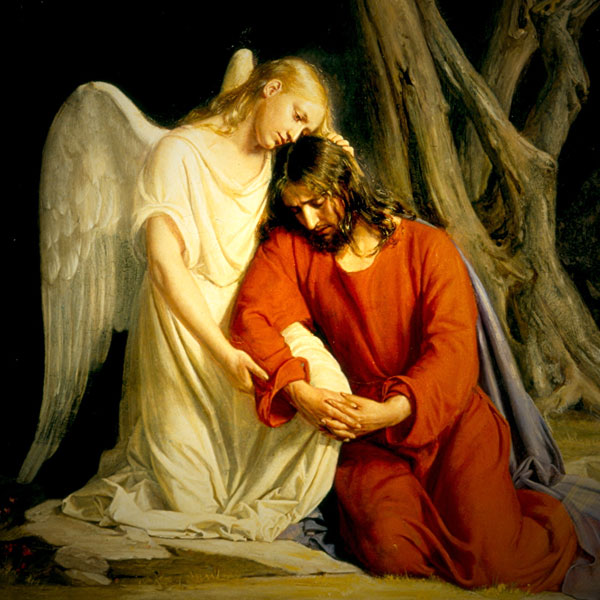
20 Mysteries: Jesus Suffers Agony in the Garden

Matthew 26:36-45:

[36] Then Jesus came with them into a country place which is called Gethsemani; and he said to his disciples: Sit you here, till I go yonder and pray. [37] And taking with him Peter and the two sons of Zebedee, he began to grow sorrowful and to be sad. [38] Then he saith to them: My soul is sorrowful even unto death: stay you here, and watch with me. [39] And going a little further, he fell upon his face, praying, and saying: My Father, if it be possible, let this chalice pass from me. Nevertheless not as I will, but as thou wilt. [40] And he cometh to his disciples, and findeth them asleep, and he saith to Peter: What? Could you not watch one hour with me?
   
[41] Watch ye, and pray that ye enter not into temptation. The spirit indeed is willing, but the flesh weak. [42] Again the second time, he went and prayed, saying: My Father, if this chalice may not pass away, but I must drink it, thy will be done. [43] And he cometh again and findeth them sleeping: for their eyes were heavy. [44] And leaving them, he went again: and he prayed the third time, saying the selfsame word. [45] Then he cometh to his disciples, and saith to them: Sleep ye now and take your rest; behold the hour is at hand, and the Son of man shall be betrayed into the hands of sinners.

Mark 14:34:

[34] And he saith to them: My soul is sorrowful even unto death; stay you here, and watch.

Luke 22:39-46:

[39] And going out, he went, according to his custom, to the mount of Olives. And his disciples also followed him. [40] And when he was come to the place, he said to them: Pray, lest ye enter into temptation.
   
[41] And he was withdrawn away from them a stone' s cast; and kneeling down, he prayed, [42] Saying: Father, if thou wilt, remove this chalice from me: but yet not my will, but thine be done. [43] And there appeared to him an angel from heaven, strengthening him. And being in an agony, he prayed the longer. [44] And his sweat became as drops of blood, trickling down upon the ground. [45] And when he rose up from prayer, and was come to his disciples, he found them sleeping for sorrow.     [46] And he said to them: Why sleep you? arise, pray, lest you enter into temptation.


Praised be Jesus Christ!

Now and forever. Amen.


We now enter into the Sorrowful Mysteries of the Rosary. These five mysteries comprise key events in Jesus' Passion and Death. For many, these five mysteries are the most difficult to meditate upon. While many of the other mysteries may be difficult to understand, or fit into Salvation history in terms of context and import, these are difficult because of the terrible suffering involved. Nevertheless, immersion into these mysteries is, in my opinion, most edifying, and allows you to grow closer to Our Lord in ways meditation on the others do not.

I will keep my exploration of this mystery to just two thoughts: Jesus as the New Adam, and the form of Jesus' suffering: agony. I think these two ideas will are very important here.

The New Adam


The Gospels do not directly refer to Jesus as an "Adam figure," but we do know this is how the early Christians thought of Him, as demonstrated by 1 Corinthians 15:22-45, and Romans 5:14. However, there are certainly events and images within the life of Christ that also point to this connection.

In this passage, in particular, Jesus enters into a "Garden." You might have noticed that the above Gospel passages don't actually call it a Garden. Well, the Gospel of John does. Alternatively, Matthew calls it a "country place" and Mark calls it a "farm." These three descriptions should suffice to establish the "Garden of Eden" symbolism. The original Garden was, well, called a Garden for one thing. For another thing it was a place of work, since man was created to work it (Genesis 2:15), as one might work the earth on a farm. Finally, the original Garden predated cities, and was therefore, by default, a "country place."

So, the setting is a Garden, and in this Garden Jesus experiences solitude, as did the original Adam. Twice Jesus came back from prayer to find His followers asleep, even though He had specifically asked them to stay awake and pray with Him. The Bride had not yet appeared.

In the original Garden, Adam was in friendship with God, and He was said to have walked with him there. Here, in the Garden of Gethsemani, Jesus is in friendship with God, and prays to the Father.

Most importantly, though, is that in the original Garden, when Eve was tempted by the Father of Lies, and fell to the temptation, and offered the same sin to Adam, Adam was silent throughout, gave in, and then blamed her for his own failing. Indeed, he even blamed God for giving Eve to him in the first place.

Jesus is essentially faced with the same problem. He foresees the death that is upon Him. He sees that the source of this death is the Bride, the Church, who is filled with sin and sinners, and it is by Her sin that He, Himself will suffer and die. The same consequences that Eve's sin presented to Adam. But, what is Jesus' response here? He asks the Father to take this cup from Him, but if He must take it, then the Father's will be done.

Why? First, because it is the Father's will, and it was the selfish will of man, in contradiction to the Word of the Father, which resulted and continues to result in sin and suffering and death. Second, because it is through this action, this submission to the Father's Holy Will that the Bride will come to be saved. So, rather than staying silent and acquiescing, like Adam, Jesus goes forth boldly to save His Bride, even from Her own sins.

So, what we are seeing here is the beginning of the New Creation. This is the work of the New Adam, set in His Garden, preparing to right what was wronged so long ago. Just as Adam, after sinning, was condemned to tilling the earth by the sweat of his brown, now Jesus is tilling the earth of salvation by sweating blood, by bleeding for us. He begins, and His beginning is that of suffering, because suffering is the first consequence of sin.

Agony


Jesus first suffering, during His Passion, is agony. I think many of us tend to think of agony as just an extreme form of suffering. But agony is actually a particular kind of suffering. Specifically, it is mental suffering, anguish, terror. It comes from the Greek word agonia, which literally means "a mental struggle for victory."

That's what we're seeing here, in Jesus' Garden. Jesus tells Peter, James and John (the three who witnessed His Transfiguration), who were nearby during Jesus' agony, "My soul is sorrowful even unto death." We ought to recognize the incredible mental anguish that Jesus was suffering here. Jesus knew He was going to suffer an excruciating kind of death. He asked His Father three times to let this trial pass Him by.

Do you remember when Jesus was in the desert, and he was fasting and praying, and the devil came to Him to tempt Him? Jesus was no doubt very hungry, probably undergoing the grouchiness effect that hunger pangs bring upon us. Yet, He had absolutely no problem telling the devil where to do. He wasn't even phased.

Here, we see something entirely different. Jesus is indeed being tempted. He speaks of temptation several times to His Disciples, here. But this temptation is of an entirely different scale. Nevertheless, despite asking repeatedly to be allowed to forego this horror, Jesus remains obedient to the Father, and accepts what is to happen to Him.

Can you imagine? Jesus was sweating blood, His anguish was so immense. Have you ever sweat blood because of how hard you had to fight against temptation? The weight of it had to have been staggering. Yet, as the word agonia suggests, His passage through it was a victory.

Mystics throughout Christian history, who have received visions of these events, tell us that what Jesus suffered here wasn't merely the terror of impending death. Rather, in this moment, Jesus opened Himself to all sin, and all suffering, from every living person, from the beginning of time to the end, and even into eternity, and exposed the horror of it to His humanity, that by this, He could make a fitting offering of Himself, and with Himself, all humanity, for the sake of our Salvation from it.

For those of you who are suffering agonies of your own, and anytime you who are not now suffering agony find yourself in such a state, pray to Jesus. He knows your pain better than you could know. He's already suffered it with you, and He is suffering it with you, and He wants nothing but to take it from you and carry it on His own shoulders. So, go to Him in the Eucharist, in the Mass, and offer it to Him. Never stop offering it to Him. It is fitting.

Thursday, June 23, 2016

20 Mysteries: The Institution of the Eucharist

Matthew 26:17-30:

[17] And on the first day of the Azymes, the disciples came to Jesus, saying: Where wilt thou that we prepare for thee to eat the pasch? [18] But Jesus said: Go ye into the city to a certain man, and say to him: the master saith, My time is near at hand, with thee I make the pasch with my disciples. [19] And the disciples did as Jesus appointed to them, and they prepared the pasch. [20] But when it was evening, he sat down with his twelve disciples.
   
[21] And whilst they were eating, he said: Amen I say to you, that one of you is about to betray me. [22] And they being very much troubled, began every one to say: Is it I, Lord? [23] But he answering, said: He that dippeth his hand with me in the dish, he shall betray me. [24] The Son of man indeed goeth, as it is written of him: but woe to that man by whom the Son of man shall be betrayed: it were better for him, if that man had not been born. [25] And Judas that betrayed him, answering, said: Is it I, Rabbi? He saith to him: Thou hast said it.     [26] And whilst they were at supper, Jesus took bread, and blessed, and broke: and gave to his disciples, and said: Take ye, and eat. This is my body. [27] And taking the chalice, he gave thanks, and gave to them, saying: Drink ye all of this. [28] For this is my blood of the new testament, which shall be shed for many unto remission of sins. [29] And I say to you, I will not drink from henceforth of this fruit of the vine, until that day when I shall drink it with you new in the kingdom of my Father. [30] And a hymn being said, they went out unto mount Olivet.

Luke 22:15-16:
[15] And he said to them: With desire I have desired to eat this pasch with you, before I suffer. 
[16] For I say to you, that from this time I will not eat it, till it be fulfilled in the kingdom of God.


Praised be Jesus Christ!

Now and forever. Amen.


I'm going to be perfectly honest with you. With respect to this particular Mystery, you will probably have read, or attended talks, or watched YouTube presentations on this subject that go much more deeply into it than I will. For example, you can watch Dr. Scott Hahn's talk on YouTube called The Fourth Cup, which I've linked here.


Given that, I hope you will forgive me if my exploration of this event is less exhaustive, but I'll do what I can.

The first thing I want to say is that this event is the source of the Catholic Church's teaching on the Eucharist, which I will explain briefly here. The Church teaches that, at the Last Supper, when Jesus spoke the words that He did over the bread and wine, that He was instituting what we call the "Eucharist," which comes from the Greek word eukharistia, which means "thanksgiving."

But, while other (but certainly not all) non-Catholic Christian groups believe that the Eucharist is a commemorative meal, and that the bread and wine taken at the meal are symbolic in nature, the Catholic Church teaches differently. Rather, the Church teaches that when a consecrated minister (priest or bishop) speaks the words that Jesus did at the Last Supper, over the bread and wine, that the substance of these things change into the actual, physical, body and blood (along with His soul and Divinity, as His natures are indivisible). The Church calls this change transubstantiation, which indicates a change in the substance only (and not, what is called in philosophy, the "accidents" of the bread and wine, which refers to its material appearance).

In this way, when Jesus says He is the True Bread from Heaven (referring to the Manna that the Israelites ate in the desert), as well as the True Vine, He intends for us to understand that we are to consume Him in the Eucharistic meal, which He institutes as the fulfillment of the Paschal meal, to be perpetuated throughout time.

This is important to understand, because in the Gospels, we see really significant events at every one of the Paschs of Jesus' ministry. We see the transformation of water into wine at the wedding of Cana. And on two other occasions (near the Pasch), Jesus feeds 5,000, and 4,000 people with a handful of bread (and fish, of course). The point here is that during Jesus ministry, we have a miracle of transformation, and two miracles of multiplication during the Pasch, and on His final Pasch before being Crucified, He institutes the Eucharist, which is both transformative (transubstantiation of the bread and wine into His Body and Blood), and multiplicative (He is fully present in all "bits" of the Eucharistic meal that He gives to us).

So, at the wedding feast of Cana, He transforms water into wine, so that the guests of the wedding might have their celebration enriched, and at the Last Supper, He transubstantiates the wine into the True Wine (Himself), that our spiritual lives might be enriched. And, again, He multiplies the bread to feed, on more than one occasion, thousands of people, to meet their need for physical nourishment, and at the Last Supper He multiplies His physical presence into all consecrated hosts that we all may receive the spiritual nourishment that we are in need of.

He Shall Betray Me


Now, the Gospels of Matthew, Mark and Luke each recount the events of the Last Supper, pretty much the same, and you can read that account above. John doesn't record the Eucharistic meal in His Gospel, but instead records Jesus' last discourse with the Apostles before His Passion.

However, even though John's account doesn't focus on the meal, He does include this part of the story. "Jesus answered: He it is to whom I shall reach bread dipped. And when he had dipped the bread, he gave it to Judas Iscariot, the son of Simon." (John 13:26) This is specifically mentioned in all four Gospels. And, if you know anything about the Gospels, you'll know that it is uncommon for all four of them to explicit recount exactly the same thing.

So, this is important.

In typical Protestant theology, there are two doctrines that they teach in contradiction to Catholic teaching. The first is that when Jesus is speaking about eating His body, or eating His flesh, even if He calls it bread, He's really just referring to His teachings. They reference Jesus' teaching on eating the bread of the Pharisees, which He explained was a reference to accepting their doctrines (Matthew 16:6-12). So, to eat the flesh of Jesus, to them means to accept His teachings, and His sacrifice.

The second is that they typically believe (though, of course, neither this teaching nor the one I just mentioned is universal among all denominations, but these are common) that once you are saved, you will always be saved, and that you become saved by accepting Jesus teachings and His sacrifice, as He taught (to eat His flesh and drink His blood).

In my opinion, this occurrence at the Last Supper confounds these two doctrines. Because if eating the bread, which is symbolic of Jesus' doctrines, is a symbolic act of taking in His doctrine within us, then we can see clearly at the Last Supper that Judas Iscariot did so, which, according to typical protestant doctrine, would indicate he was saved. But then He betrays Jesus, almost immediately, confounding the idea that He would always be saved. Especially, since Jesus says of him who betrays Him that it were better he was never born, implying his damnation.

We see a warning about this in 1 Corinthians 11:27-29. And here, St. Paul is speaking specifically about the practice of the Eucharistic meal, not about doctrine. This refutes the idea that Jesus' teaching about eating His flesh and blood is simply about accepting His doctrine, otherwise how could one be "guilty of the body" if it were simply about doctrine. If it were, then one would be "guilty of the bread," which is what Jesus' teaching about the leaven of the Pharisees was about.

But, really, I think this is a dire warning to us, who believe, more than anything. Judas was partaking of the meal, and had already made the decision to betray Jesus. Jesus makes it a point to reveal His betrayer through the meal. Think of the thousands of different ways Jesus could have revealed Judas for who he was, and on hundreds of different occasions. Instead, He chose that moment when He instituted the most intimate communion of persons, between Himself and all of us.

That should strike you as troubling, I should hope, because by it He is showing the importance of this event. Aren't we all Judas Iscariot? Do we not all go to Mass, take communion, then go home and betray Jesus by our sins that we almost never cease doing? This is why the Church has in place two very important restrictions when it comes to partaking of the Eucharist.

First, you must know what it is you do. If you are not Catholic, and do not believe the Eucharist to be what it is, Jesus' True Presence, then you are not permitted to enter into a communion with Him, and His community of believers, when doing so would be a lie.

Second, you must be in a state of Sanctifying Grace. That is, you must not have any unrepentant mortal sins on your soul. For, if you do, then you are no better than the Betrayer, and you partake of the Eucharistic meal, again, in falsehood. You blaspheme the Sacrament. And, as Jesus said, it would be better if you were not born (true of all sins that destroy your soul to death).

A Hymn Being Said


But the Eucharist is a gift! It is a great gift of joy and thankfulness! By it, we are permitted to enter into communion with the Trinity, into their community of Love. We call full communion (of the kind we will be permitted in Heaven) with this community the Beatific Vision because it is beautiful, and joyous and filled with love. The Eucharist is supposed to be, for us, a taste of that vision. We call it the Eucharistic Celebration, or celebration of thanksgiving for the great gift of Jesus that we have received.

This is why the Eucharist is called by the Church the source and summit of our Faith (Catechism of the Catholic Church 1324). It is called the source of our Faith because it feeds our Faith, gives it life, nourishes it (as bread it satisfies our need). Through communion with Jesus, who is God, the source of all life and love, our spiritual lives are sustained, and given rebirth each time we partake of this food. It is called the summit of our Faith because it enriches our Faith, makes it sweet and lovely (as wine, it enhances our spiritual experience with beauty). Through communion with Jesus, who is God, the source of all goodness and beauty, our spirits are uplifted to heights unthinkable by our own efforts.

And so, in joy and love, the Apostles, with Jesus, sang a Paschal hymn. And with that, I'm going to leave you with a beautiful old roman Catholic chant.

Kyrie Eleison