[6] Jesus saith to him: I am the way, and the truth, and the life. No man cometh to the Father, but by me.
John 14:12:
[12] Otherwise believe for the very works' sake. Amen, amen I say to you, he that believeth in me, the works that I do, he also shall do; and greater than these shall he do.
John 14:17:
[17] The spirit of truth, whom the world cannot receive, because it seeth him not, nor knoweth him: but you shall know him; because he shall abide with you, and shall be in you.
John 14:27:
[27] Peace I leave with you, my peace I give unto you: not as the world giveth, do I give unto you. Let not your heart be troubled, nor let it be afraid.
John 15:3-5:
[3] Now you are clean by reason of the word, which I have spoken to you. [4] Abide in me, and I in you. As the branch cannot bear fruit of itself, unless it abide in the vine, so neither can you, unless you abide in me. [5] I am the vine: you the branches: he that abideth in me, and I in him, the same beareth much fruit: for without me you can do nothing.
John 15:9-10:
[9] As the Father hath loved me, I also have loved you. Abide in my love. [10] If you keep my commandments, you shall abide in my love; as I also have kept my Father' s commandments, and do abide in his love.
John 15:11-15:
[11] These things I have spoken to you, that my joy may be in you, and your joy may be filled. [12]This is my commandment, that you love one another, as I have loved you. [13] Greater love than this no man hath, that a man lay down his life for his friends. [14] You are my friends, if you do the things that I command you. [15] I will not now call you servants: for the servant knoweth not what his lord doth. But I have called you friends: because all things whatsoever I have heard of my Father, I have made known to you.
John 15:18:
[18] If the world hate you, know ye, that it hath hated me before you.
John 15:20:
[20] Remember my word that I said to you: The servant is not greater than his master. If they have persecuted me, they will also persecute you: if they have kept my word, they will keep yours also.
John 16:6-11:
[6] But because I have spoken these things to you, sorrow hath filled your heart. [7] But I tell you the truth: it is expedient to you that I go: for if I go not, the Paraclete will not come to you; but if I go, I will send him to you. [8] And when he is come, he will convince the world of sin, and of justice, and of judgment. [9] Of sin: because they believed not in me. [10] And of justice: because I go to the Father; and you shall see me no longer. [11] And of judgment: because the prince of this world is already judged.
John 16:20:
[20] Amen, amen I say to you, that you shall lament and weep, but the world shall rejoice; and you shall be made sorrowful, but your sorrow shall be turned into joy.

Praised be Jesus Christ!
Now and forever. Amen.
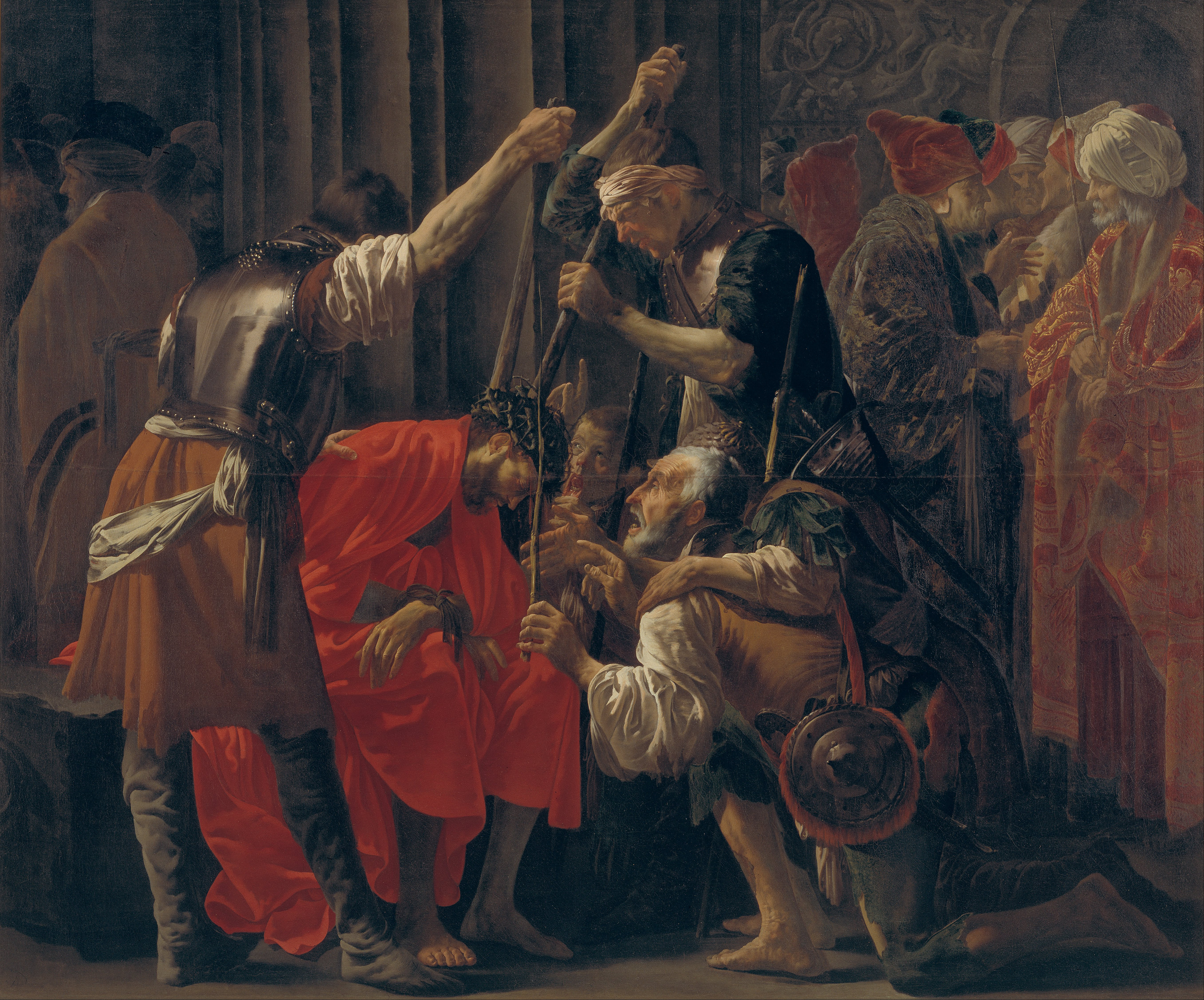
In part I of this "miniseries," I mentioned that in this third part I would delve deeper into the centrality that suffering takes in His Kingdom, at least for the time being, and that I would examine how Jesus approaches suffering both in this mystery, and the others, why He approaches it this way, and why doing likewise will lead to great joy for us.
Well, here we are. I think by examining these latter questions, regarding Jesus' approach to suffering, we may come to understand why suffering is a central part of His Kingdom, though, in the end, some words will certainly need to be said about it.
Before I begin, though, I would like to take this opportunity to summarize the previous two parts. In part I, I looked at the Mystery of Jesus' coronation with a wreath of thorns, as emblematic of the Person of Jesus, as God, as King, as sufferer, as victor, as bridegroom. I pointed out that all of Jesus' sufferings from the previous Mysteries were present still, and that they would remain to His death, that from His agony in the Garden of Gethsemani, His suffering only grew, and would continue to grow to its culmination in His death.
In part II, I explored the origins of human suffering and death in the Fall of our first king, Adam, through his Original Sin, which was a sin of pride, of disobedience, and of hatred. This Original Sin has left its mark on all of human history. It has marred human relationships, from romance to politics. It, and all human sin, is the source of human suffering, and of human death, both physical and spiritual.
Jesus came to change this. So, let's look at that.
In Jesus' discourse to the Apostles just prior to His Passion, He explains that He must "go to the Father," and that when He does, He will send the "Paraclete" (or Consoler), and that this Paraclete would "convince the world of sin, and of justice, and of judgement" (John 16:8). This teaching, I believe, gives us the key reasons for Jesus' coming.
He came because of sin, which is the source of human suffering and death. He came because of justice, because without it, sin and death would persist. He came because of judgement, because without justice for humanity, the judgement of Hellfire is certain, as it is certain for the demons. The central element here is justice: it restores the ill that has gone before it, and it prevents the ills that may yet come.
Justice, then, is the central reason. But there is something else here that goes beyond logic. Logic and reason come out of God, they are expressions of unity, consistency, and integrity of His infinite and eternal intellect. This is true, also, of Justice, which is an expression of the unity, consistency, and integrity of His infinite and eternal will. But the central character of God is different. It is both reasonable and just, but it is neither of these things. It is what we call Love.
And it is for Love, that Jesus came. "Greater love than this no man hath, that a man lay down his life for his friends" (John 15:13). If Jesus came to suffer and die for us, then it is for this reason: love.
But the question has to be asked, why is suffering so important? Why did Jesus have to endure such terrible suffering, and even death? If love and justice are the answers, why do these things demand suffering? The truth is that love and justice do not demand suffering, of themselves. They do demand this in the face of sin, though.
By sin, we violate our relationship with God, and we harm our own natures. The two consequences of sin are suffering and death. This is the teaching of the Church, a fact of our Faith.
By way of analogy we can understand the "mechanics" of what's going on here. If you take a knife, and you make a cut in your arm, we may say that you have violated the natural integrity of your arm, separating the skin and muscle tissues. This "state" is, in a sense, unnatural. It is also painful, and that pain is a natural consequence to the unnatural state of your arm being cut.
If we try to remove the natural consequence of pain, that leads us to all kinds of problems. The body's nervous system responds to the pain, and activates it's natural healing mechanisms. The blood begins to clot, forming a scab over the wound, a protective barrier that will allow the wound to heal, and to prevent further blood loss. If we could remove pain from our experience of that wound, our body's nervous system would not activate, the clot would not form, the wound would not heal, blood would continue to flow out of it, and it could very well become infected. This, inevitably, will lead to death. We see this in leprosy, wherein the body's nervous system begins to shut down, and over time parts of the body go numb, and pain reception is lost.
But, besides activating that which causes healing, pain also acts as a warning against future wounds. Having felt the pain of having my arm cut, I will work to prevent this occurring again in the future. If I remove the pain, I will not avoid this in the future, causing further wounds, which, accumulating, will lead to death more quickly.
This is how sin works. This analogy is as applicable to the corruption of our natures, as it is to the corruption of relationships. Thus, because the natural consequences of sin are suffering and death, in order to heal the wounds left by sin, it is right and just that we accept these consequences, without attempt at avoidance of them. In accepting these consequences, and allowing them to occur in our lives, we begin the healing process. If we attempt to avoid them, we will only fall further into the death-state of our sinfulness.
Thus, whatever healing Jesus would accomplish in His work of Salvation, it had to come by way of suffering and death. This is the only justice manner of our healing. What we lost, we regain by accepting the consequences of our sin: suffering and death.
This is an incomplete picture, however. Justice demands a right and fitting restoration against the crime committed. If what we lost, we lost by way of a particular kind of sin, the to regain what was lost, it must be regained in a fitting act of goodness. The practice of "serving time," for example, may be a just punishment for some crimes, but not a just punishment for others.
The sin of our first king was particular. It was first an act of pride, second an act of disobedience, and third an act of hatred (turning back on God). The act itself was that of reaching for Divinity, the right to determine truth and goodness according to his own choosing. The restorative act, then, had to be a fitting counterpoint to this.
Thus, Jesus "Who being in the form of God, thought it not robbery to be equal with God: But emptied himself, taking the form of a servant, being made in the likeness of men, and in habit found as a man" (Philippians 2:6-7). This was an act of humility; He did not deem Divinity to be something to be sought after at in His humanity. Adam was proud, seeking Divinity.
Thus, Jesus "Saying: Father, if thou wilt, remove this chalice from me: but yet not my will, but thine be done" (Luke 22:42). This was an act of obedience; He accepted God's will, even if it meant death. Adam disobeyed God's will, even if it meant death.
Thus, Jesus "[...] also hath loved us, and hath delivered himself for us, an oblation and a sacrifice to God for an odour of sweetness." This was an act of love; He loved us, and he loved the Father, and He lived for both. Adam sinned out of love for himself only. By his sin, he violated his relationship with God, and his relationship with Eve.
Jesus is our True King, who leads us into all glory. He leads us into truth, He leads us into goodness, and he leads us into life and love. He does so by showing us His way of suffering. So, let us abide in the love of Jesus, by following His commandments.
Let us be particularly attentive to this one: "If any man will follow me, let him deny himself, and take up his cross, and follow me" (Mark 8:34).
God bless.
John 16:20:
[20] Amen, amen I say to you, that you shall lament and weep, but the world shall rejoice; and you shall be made sorrowful, but your sorrow shall be turned into joy.

Now and forever. Amen.
In part I of this "miniseries," I mentioned that in this third part I would delve deeper into the centrality that suffering takes in His Kingdom, at least for the time being, and that I would examine how Jesus approaches suffering both in this mystery, and the others, why He approaches it this way, and why doing likewise will lead to great joy for us.
Well, here we are. I think by examining these latter questions, regarding Jesus' approach to suffering, we may come to understand why suffering is a central part of His Kingdom, though, in the end, some words will certainly need to be said about it.
Before I begin, though, I would like to take this opportunity to summarize the previous two parts. In part I, I looked at the Mystery of Jesus' coronation with a wreath of thorns, as emblematic of the Person of Jesus, as God, as King, as sufferer, as victor, as bridegroom. I pointed out that all of Jesus' sufferings from the previous Mysteries were present still, and that they would remain to His death, that from His agony in the Garden of Gethsemani, His suffering only grew, and would continue to grow to its culmination in His death.
In part II, I explored the origins of human suffering and death in the Fall of our first king, Adam, through his Original Sin, which was a sin of pride, of disobedience, and of hatred. This Original Sin has left its mark on all of human history. It has marred human relationships, from romance to politics. It, and all human sin, is the source of human suffering, and of human death, both physical and spiritual.
Jesus came to change this. So, let's look at that.
He Will Convince the World
In Jesus' discourse to the Apostles just prior to His Passion, He explains that He must "go to the Father," and that when He does, He will send the "Paraclete" (or Consoler), and that this Paraclete would "convince the world of sin, and of justice, and of judgement" (John 16:8). This teaching, I believe, gives us the key reasons for Jesus' coming.
He came because of sin, which is the source of human suffering and death. He came because of justice, because without it, sin and death would persist. He came because of judgement, because without justice for humanity, the judgement of Hellfire is certain, as it is certain for the demons. The central element here is justice: it restores the ill that has gone before it, and it prevents the ills that may yet come.
Justice, then, is the central reason. But there is something else here that goes beyond logic. Logic and reason come out of God, they are expressions of unity, consistency, and integrity of His infinite and eternal intellect. This is true, also, of Justice, which is an expression of the unity, consistency, and integrity of His infinite and eternal will. But the central character of God is different. It is both reasonable and just, but it is neither of these things. It is what we call Love.
And it is for Love, that Jesus came. "Greater love than this no man hath, that a man lay down his life for his friends" (John 15:13). If Jesus came to suffer and die for us, then it is for this reason: love.
Jesus tells us, "I am the way, and the truth, and the life" (John 14:6). Goodness is the proper object of the will. So, Jesus shows us the Way of Goodness. Truth is the proper object of the intellect. So, Jesus teaches us the Truth. Life is the proper object of love. So, Jesus came to give us life. The most important of these is love, because the lie leads to death, the sin leads to death, and hatred leads to death, and the only path to life is love. So, truth and goodness are reliant on love.
It is therefore, out of Love, that Jesus came to us. He came to give us life. But, remember, untruth and evil lead to death, they lead to hatred, therefore, it is not for love alone that Jesus came, but to restore us in fullness, by teaching us the truth, that we may know the truth and not be susceptible to deception, and by acting in complete goodness, that we may walk in His path, and obey His commandments into all goodness.
By this, our natures might be restored.
The Justice of Suffering
But the question has to be asked, why is suffering so important? Why did Jesus have to endure such terrible suffering, and even death? If love and justice are the answers, why do these things demand suffering? The truth is that love and justice do not demand suffering, of themselves. They do demand this in the face of sin, though.
By sin, we violate our relationship with God, and we harm our own natures. The two consequences of sin are suffering and death. This is the teaching of the Church, a fact of our Faith.
By way of analogy we can understand the "mechanics" of what's going on here. If you take a knife, and you make a cut in your arm, we may say that you have violated the natural integrity of your arm, separating the skin and muscle tissues. This "state" is, in a sense, unnatural. It is also painful, and that pain is a natural consequence to the unnatural state of your arm being cut.
If we try to remove the natural consequence of pain, that leads us to all kinds of problems. The body's nervous system responds to the pain, and activates it's natural healing mechanisms. The blood begins to clot, forming a scab over the wound, a protective barrier that will allow the wound to heal, and to prevent further blood loss. If we could remove pain from our experience of that wound, our body's nervous system would not activate, the clot would not form, the wound would not heal, blood would continue to flow out of it, and it could very well become infected. This, inevitably, will lead to death. We see this in leprosy, wherein the body's nervous system begins to shut down, and over time parts of the body go numb, and pain reception is lost.
But, besides activating that which causes healing, pain also acts as a warning against future wounds. Having felt the pain of having my arm cut, I will work to prevent this occurring again in the future. If I remove the pain, I will not avoid this in the future, causing further wounds, which, accumulating, will lead to death more quickly.
This is how sin works. This analogy is as applicable to the corruption of our natures, as it is to the corruption of relationships. Thus, because the natural consequences of sin are suffering and death, in order to heal the wounds left by sin, it is right and just that we accept these consequences, without attempt at avoidance of them. In accepting these consequences, and allowing them to occur in our lives, we begin the healing process. If we attempt to avoid them, we will only fall further into the death-state of our sinfulness.
Thus, whatever healing Jesus would accomplish in His work of Salvation, it had to come by way of suffering and death. This is the only justice manner of our healing. What we lost, we regain by accepting the consequences of our sin: suffering and death.
Our True King
This is an incomplete picture, however. Justice demands a right and fitting restoration against the crime committed. If what we lost, we lost by way of a particular kind of sin, the to regain what was lost, it must be regained in a fitting act of goodness. The practice of "serving time," for example, may be a just punishment for some crimes, but not a just punishment for others.
The sin of our first king was particular. It was first an act of pride, second an act of disobedience, and third an act of hatred (turning back on God). The act itself was that of reaching for Divinity, the right to determine truth and goodness according to his own choosing. The restorative act, then, had to be a fitting counterpoint to this.
Thus, Jesus "Who being in the form of God, thought it not robbery to be equal with God: But emptied himself, taking the form of a servant, being made in the likeness of men, and in habit found as a man" (Philippians 2:6-7). This was an act of humility; He did not deem Divinity to be something to be sought after at in His humanity. Adam was proud, seeking Divinity.
Thus, Jesus "Saying: Father, if thou wilt, remove this chalice from me: but yet not my will, but thine be done" (Luke 22:42). This was an act of obedience; He accepted God's will, even if it meant death. Adam disobeyed God's will, even if it meant death.
Thus, Jesus "[...] also hath loved us, and hath delivered himself for us, an oblation and a sacrifice to God for an odour of sweetness." This was an act of love; He loved us, and he loved the Father, and He lived for both. Adam sinned out of love for himself only. By his sin, he violated his relationship with God, and his relationship with Eve.
Jesus is our True King, who leads us into all glory. He leads us into truth, He leads us into goodness, and he leads us into life and love. He does so by showing us His way of suffering. So, let us abide in the love of Jesus, by following His commandments.
Let us be particularly attentive to this one: "If any man will follow me, let him deny himself, and take up his cross, and follow me" (Mark 8:34).
God bless.